
2026 TALENT REPORT HIGHLIGHTS
This digital report contains curated highlights from our biennial Talent Report. To read all of the exclusive insights and explore the sources from this comprehensive report, please download it here.

THE TALENT LANDSCAPE IN GREATER GRAND RAPIDS (GGR)
The talent landscape has changed in recent years, and Greater Grand Rapids is entering this new landscape from a position of demographic strength.
At a time when communities across the country are contending with aging populations and declining birth rates, Greater Grand Rapids’ talent base is younger, more diverse, and increasingly well educated. Having added 2,000 new jobs in 2025, the region is a hub for 25-to-34-year-old workers, the concentration of which outpaces state and national figures, and ranks fifth among 16 peer metros outside Michigan.
1,183,936
POPULATION IN 2025
Source: U.S. Census Bureau (Population Estimates Program)
621,936
LABOR FORCE IN JANUARY 2026
Source: U.S. Bureau of Labor Statistics (Civilian Labor Force, Smoothed Seasonally Adjusted)
4.3%
AVERAGE HOURLY WAGE IN JANUARY 2026
Source: U.S. Census Bureau of Labor Statistics (Average Hourly Earnings, Not Seasonally Adjusted)
$33.18
UNEMPLOYMENT RATE IN JANUARY 2026
Source: U.S. Census Bureau of Labor Statistics (Unemployment Rate, Smoothed Seasonally Adjusted)
THE LABOR MARKET REBALANCED
The national labor market has shifted from one defined by twice as many job openings as people to fill them at its peak, to a labor market with more unemployed people than openings in recent months. In Michigan, this shift is even starker, having flipped to more unemployment than openings in mid-2024.
This shift underscores a new talent landscape, one that is different from much of the past decade. While the labor force continues to grow, workers are competing for fewer available job openings than previous years. Meanwhile, many employers have tightened hiring to hedge against economic uncertainty.
Job Openings vs. Unemployment
Source: Bureau of Labor Statistics (Unemployment Seasonally Adjusted and Job Openings Total Nonfarm Seasonally Adjusted)
In this chart, 1 represents balance.
When the lines in this chart rise above 1, there are more job openings than unemployed people.
When the lines in this chart dip below 1, there are more unemployed people than job openings.
Employment Trends
Despite the changes to the labor market, employers remain optimistic. Companies across Greater Grand Rapids plan to continue adding workers and expanding, though at a slower rate than previous years, according to data from The Right Place. Likewise, the share of companies forecasting stable employment in 2025 remained largely unchanged from the previous year.
2,000
JOBS ADDED IN GGR IN 2025
Source: Bureau of Labor Statistics (Total Nonfarm, Seasonally Adjusted)

Greater Grand Rapids’ Competitive Edge
Across the country, communities and companies alike are experiencing widespread demographic shifts. Greater Grand Rapids is becoming increasingly diverse, and the region is uniquely positioned to benefit from these shifting demographics.
25-to-34 Year Old Workers
As populations across the nation fluctuate, regions that successfully attract young workers will be better positioned for economic success. The concentration of 25-to-34-year-old workers in Greater Grand Rapids not only outpaces Michigan and the United States but outperforms the majority of its peers.
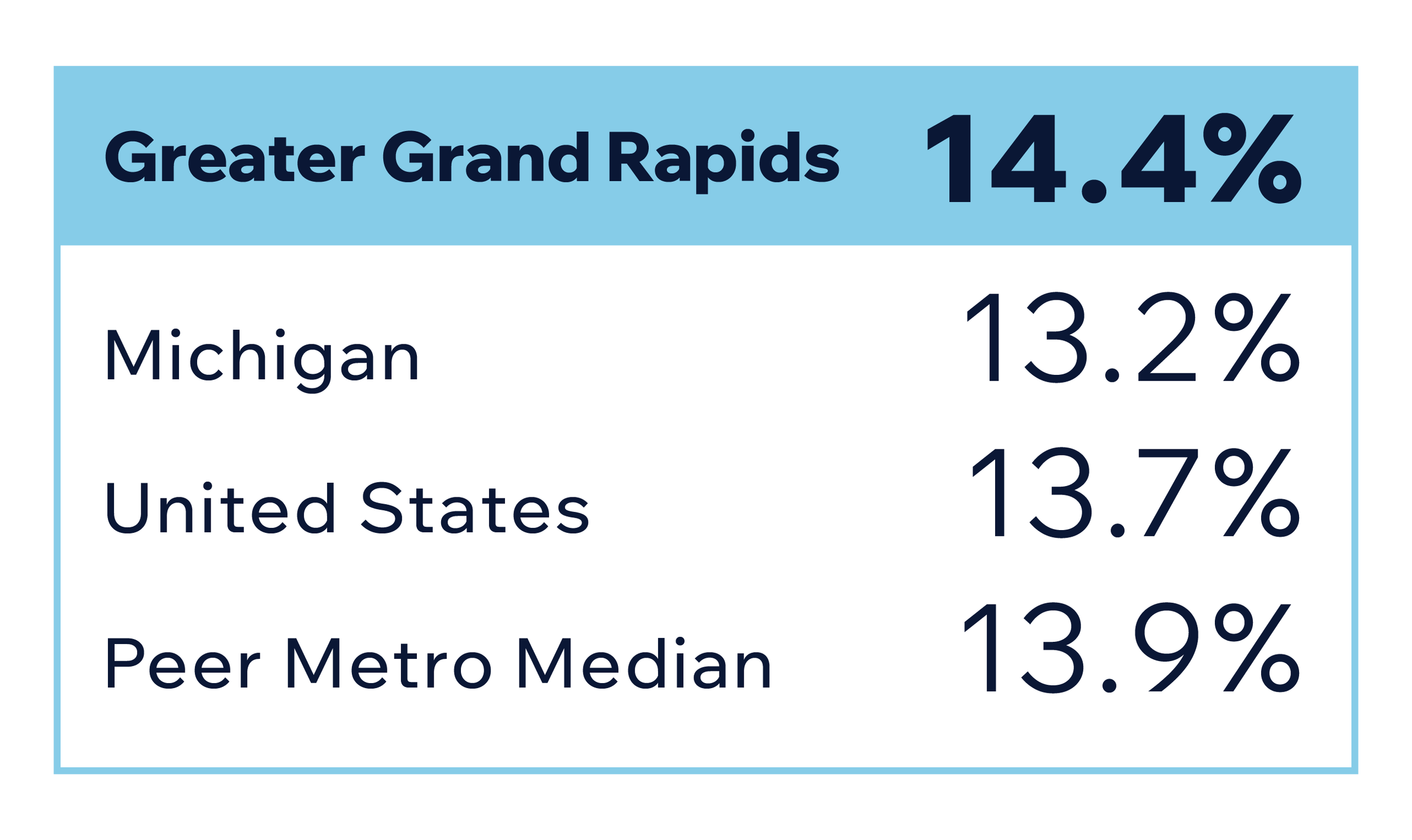
25-to-34-Year-Old Share of the Population in 2025:
Source: Lightcast
Diverse Populations
The concentration of diverse populations in Greater Grand Rapids lags state and national figures but grew faster (39.3%) from 2005 to 2025 compared to Michigan (23.2%) and the U.S. (29.9%). Since 2015, diverse populations have driven more than half of Greater Grand Rapids' population growth.
69%
TOTAL POPULATION GROWTH DRIVEN BY DIVERSE POPULATIONS IN GGR FROM 2005 TO 2025
Source: Lightcast
Education Trends
After several years of consecutive decline, undergraduate enrollment in Greater Grand Rapids increased 27% (1,273 students) from 2022 to 2024. Enrollment declines generally track fluctuations in population. Nationally, undergraduate enrollment declined 5.3% from 2015 to 2024. The region’s population continues to be better educated. The share of people with a bachelor’s degree or higher increased 8 percentage points to 37% from 2015 to 2025.
37%
SHARE OF PEOPLE WITH A BACHELOR’S DEGREE OR HIGHER IN GGR
(AN INCREASE OF EIGHT PERCENTAGE POINTS FROM 2015 TO 2025)
Source: Lightcast

AI and the New Era of Work
At the same time that the labor market is rebalancing, the nature of work is changing at an unprecedented pace. The proliferation of AI technologies has reshaped how people work, train, and hire. Job postings referencing AI-related skills in Greater Grand Rapids more than doubled since 2022. Likewise, wages for AI-related positions increased 24% since 2022 and 27% from the previous year – a 66% premium above the region’s median hourly wage of $33.18.
835
IN 2025
436
IN 2024
314
IN 2023
282
IN 2022
Source: Lightcast (see full report for more details)
The Right Place’s Business Intelligence team is dedicated to providing valuable insights into the economic landscape of the Greater Grand Rapids region.
Annually, our team researches and authors comprehensive reports covering a variety of key industries
These reports dive into the development, tech, manufacturing, and talent sectors of our region, offering a detailed analysis of trends, challenges, and opportunities. At the end of each year, we also release the State of the Region report, which is designed to give an in-depth look at the key economic trends in Greater Grand Rapids.

© 2026 The Right Place, Inc